







Baccarat is often seen as a card game that is “easier to get into than it looks,” because players do not have to remember as many decisions as in blackjack or track as many symbols as in slots. The most important thing is to understand how wins and losses are decided, know how the three main betting options work, and avoid emotional thinking when following table streaks. For beginners, it can be a suitable game for getting used to the pace of online casinos, as long as you approach it with a clear mindset, small bets, and a solid grasp of the basics before playing with real money. If you still need a broader foundation, you can also read basic online casino knowledge.
What is online baccarat?
Online baccarat is the digital version of traditional baccarat, where you bet on one of three main outcomes: Player, Banker, or Tie. The goal is not to build the strongest hand yourself, but to predict which side will finish closer to 9 after cards are dealt according to fixed rules. Because players do not have to make many decisions during the hand, baccarat is often considered beginner-friendly.
In the online environment, baccarat usually appears in two common forms. One is RNG baccarat, where software deals the cards automatically. The other is live baccarat, where a real dealer deals cards through a live video stream. If you want to better understand the real-table experience, you can also read the article about baccarat with a real dealer.
What makes baccarat appealing to beginners is its fast pace, simple interface, and limited number of core betting options. Still, “simple” does not mean you should play on impulse. Many new players look at the roadmaps, see long Banker or Player streaks, and assume they can confidently predict the next hand. In reality, that way of thinking often leads to poor control.
Another important point is that baccarat can create strong emotional swings even though the rules are simple. Just a few wins in a row can tempt a beginner to increase bets too quickly. That is why, before learning tips or strategies, the most valuable step is still understanding how the game works and keeping yourself at low-stakes levels.
From the perspective of an editor writing for beginners, I consider baccarat one of the easiest casino games to learn. But precisely because it is easy to learn, many people become overconfident and overlook details like the commission on Banker bets or the low probability of Tie. The mistake usually does not come from difficult rules, but from partial understanding followed by overly confident betting.
Basic baccarat rules
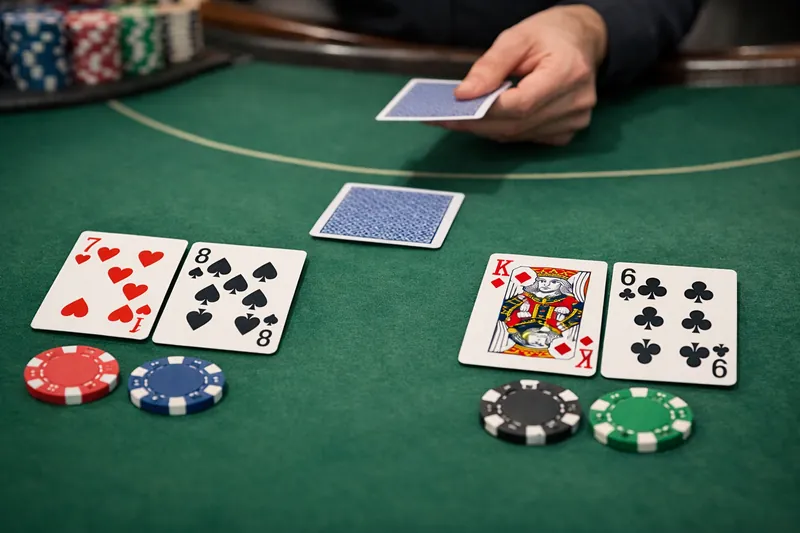
The basic rules of baccarat center on adding up card values to see which side is closer to 9. In baccarat, an Ace counts as 1 point; cards from 2 to 9 keep their face value; 10, J, Q, and K all count as 0. If the total of two or three cards is greater than 9, you only keep the last digit. For example, 7 + 8 = 15, which counts as 5; 9 + 6 = 15 also counts as 5.
Each round usually starts by dealing two cards to Player and two cards to Banker. Then, depending on the current totals, the system determines whether a third card is drawn according to preset rules. Players do not choose whether to hit or stand. This is a very important point: in baccarat, you only bet on the outcome, while the dealing process runs automatically under fixed rules.
Some basic rules to remember:
- If the starting total is 8 or 9, it is a natural; the round usually ends immediately.
- If Player has a total of 0-5, Player usually draws a third card; if the total is 6-7, Player stands.
- Banker’s drawing rules are a bit more complex and depend on Banker’s total and Player’s third card.
- The side closer to 9 wins.
- If both sides have the same total, the result is a Tie.
As a beginner, you do not need to memorize the full Banker drawing table on your first day. Most online baccarat tables apply the rules automatically, so what matters is understanding why cards are sometimes drawn and sometimes not. Once you understand that logic, the game feels much less like “everything is happening too fast and I do not know why.”
| Card | Baccarat value | Easy example |
|---|---|---|
| A | 1 point | A + 8 = 9 |
| 2 to 9 | Keep face value | 4 + 3 = 7 |
| 10, J, Q, K | 0 points | K + 7 = 7 |
| Total over 9 | Keep the last digit | 7 + 8 = 15, counts as 5 |
The key takeaway is that baccarat does not require you to be “great at card play” in the sense of memorizing layered strategies. This game is more about understanding the rules, choosing reasonable betting options, and staying disciplined with your bankroll. If you approach it as a straightforward probability game, you are less likely to get pulled into false beliefs about winning and losing streaks.
What is the difference between Player, Banker, and Tie?
The three main betting options in baccarat are Player, Banker, and Tie. This is the part beginners need to understand clearly, because even though they are all on the same table, their safety and risk profiles are very different. Many new players see the name “Banker” and assume it means betting on the house, so they avoid it. In reality, that is not the case. In baccarat, Banker is simply one of the two hands being dealt, not a bet that the casino will beat you.
Player means you are betting that the Player hand will finish with a higher total than the Banker hand. If the bet wins, the standard payout is usually 1:1. This is the easiest option for beginners to understand because standard tables generally do not deduct commission from the winnings.
Banker means you are betting that the Banker hand will win. This is often the option with a slightly better chance of winning because of the way the drawing rules are structured. However, because of that edge, casinos usually charge around 5% commission on the profit from a winning Banker bet. Even with that commission, Banker is still often viewed as the more stable choice in probability terms.
Tie means you are betting that both sides will end with the same total. The payout is usually much higher, which makes it appealing to beginners. But the chance of a Tie happening is significantly lower. That makes Tie a much riskier option and not a good main choice when you are still learning the game.
To make it easier to remember:
- Player: simple, straightforward payout, good for learning.
- Banker: usually a slightly better probability, but with commission.
- Tie: high payout but rare, so it should not be overused.
A very common mistake is seeing the high payout on Tie and assuming it is a “quick profit opportunity.” In practice, a higher payout always comes with lower probability. If you do not yet have good bankroll discipline, putting too much on Tie can make your budget swing sharply in only a few rounds.
If you are still wondering which casino game to try first, baccarat can be a strong option for learning how to read a table, understand basic probability, and get used to the betting rhythm. Just do not confuse a simple interface with actual control over the outcome.
How to start a baccarat round

When starting a round of online baccarat, the first thing you should do is not place a bet right away, but look over the table interface. Check the minimum and maximum stakes, the betting areas, the countdown timer, and the history of previous rounds. The goal of this step is to make sure you understand the table environment before putting money in. For beginners, simply choosing a table with a low minimum bet already reduces a lot of mental pressure.
A baccarat round usually follows this sequence:
- You choose a table that fits your budget.
- The system opens the betting window.
- You place your bet on Player, Banker, or Tie.
- Betting closes when the timer runs out.
- Cards are dealt automatically or by the live dealer.
- The system applies the third-card rules if needed.
- The result is announced and the win or loss is updated.
One important thing to keep in mind is that beginners are often drawn to the roadmap display as soon as they enter the table. That display only shows previous results; it does not guarantee that the next round will continue in the same pattern. You can use it to follow the flow of the table, but you should not treat it as a “sure-win prediction system.”
A sensible way to begin is to choose one small fixed stake for your first 10-20 rounds just to get used to the rhythm. During this phase, your goal should be to learn how to observe, understand the flow, and control your emotions rather than try to maximize profit. When beginners skip this adjustment stage, they often raise their stake after only a few wins and then lose control in the rounds that follow.
Also, check what kind of table you are playing on. Some tables include variations or side bets. If you do not fully understand them yet, it is best to stick to the three basic bets. Do not let a colorful interface or flashy side-bet payouts pull you away from your original plan.
A practical tip I always give beginners is to spend a few minutes watching the table before betting. Simply observing the dealing speed, betting time, and how results are displayed can help you avoid a lot of misclicks or rushed decisions. In live baccarat, this adjustment step also helps you spot tables that move too fast for your comfort level.
Mistakes beginners should avoid
The biggest beginner mistake in baccarat is not “not knowing the rules,” but understanding just a little and then overinterpreting everything. Because baccarat offers only a few betting choices, many people quickly assume they fully understand the game. In reality, the hardest part is staying disciplined during winning and losing streaks and not turning a simple game into a chain of emotional decisions.
Some very common mistakes include:
- Blindly following streaks: seeing Banker win several rounds in a row and assuming the next one must also be Banker, or on the contrary believing “it has to switch now.” Neither line of thinking is based on any real guarantee.
- Betting too much on Tie: the high payout is tempting, but this is a much lower-probability bet.
- Increasing bets after repeated losses: beginners often want to recover quickly, which makes bet size grow beyond the original plan.
- Ignoring Banker commission: you win, but receive less than expected, which can throw off your bankroll calculations.
- Playing when tired or impatient: baccarat moves quickly, so just a few distracted decisions can push your budget far off course.
Another less discussed mistake is choosing a table that does not suit your bankroll. If your budget is small but you sit at a table with a high minimum bet, you are forced to take more risk on every round. In that case, even if you understand the rules correctly, it is still hard to maintain a safe pace.
You should also avoid treating baccarat as a game where you can “win it back fast.” Many beginners move from slots to baccarat and think this game is easier to control, so they start increasing their money too aggressively. It is true that baccarat is more transparent in how bets work, but that does not make short-term outcomes predictable.
The best way to avoid mistakes is to set three limits in advance: your bet size per round, your maximum session loss, and your maximum playing time. If you hit any one of those limits, stop. The rule sounds simple, but that is exactly what makes baccarat truly beginner-friendly rather than emotionally overwhelming.
Is baccarat suitable for beginners?

In terms of game rules, baccarat is one of the most beginner-friendly casino games. You do not have to make a long series of strategic decisions in each round. If you understand how scoring works, know what Player, Banker, and Tie mean, and choose a suitable stake, you can already take part. Compared with many other card games in online casinos, baccarat has a much lower learning barrier.
That said, suitable does not mean harmless. Baccarat is beginner-friendly because it is easy to learn, but it can still become difficult to control if you confuse “easy to play” with “easy to win.” Its fast pace and simple layout often lead players to keep betting without noticing how many rounds they have already played in a short time.
Baccarat is especially suitable for beginners if you are in one of these groups:
- You want to start with a game that has short, easy-to-remember rules.
- You do not enjoy games that require complex strategic actions.
- You want to observe probability and outcomes in a more direct way.
- You can accept that you do not control the card draw, only your betting choices and bankroll.
On the other hand, baccarat may not be the best choice if you are easily pulled into fast betting streaks, tend to chase losses with progressive betting, or always look for the highest possible payout. In those situations, baccarat’s simplicity can actually make you careless.
For beginners in Vietnam who want a broader view of casino experience for beginners, baccarat should be treated as a starting game for learning discipline, not as a place to test your luck with large betting streaks. If you approach it correctly, it is a fairly clear, transparent game and a good way to build your online casino knowledge. If you approach it the wrong way, you can still fall into the same old mistakes: playing emotionally, overreading streaks, and forgetting your limits.
Frequently Asked Questions
Below are the questions beginners ask most often when first learning about online baccarat. The answers are short, but they go straight to the point so you can use them as a quick review before sitting down at a table.
Is online baccarat hard to learn?
Not really compared with many other casino games. You mainly need to understand how points are counted, know the three main betting options, and remember that card drawing follows fixed rules. The harder part is staying disciplined and not chasing winning or losing streaks.
Should beginners choose Player or Banker?
For beginners, both are much easier to approach than Tie. Banker usually has a slightly better chance of winning, but commission is often deducted from the profit. Player is simpler and easier to track in terms of payout. The key is to use a steady approach and not switch back and forth emotionally.
Should you bet on Tie because the payout is high?
In most cases, no. Tie should not be your main betting option when you are still new. The higher payout comes with a clearly lower chance of happening. If you overuse Tie, your bankroll will swing more sharply and it becomes much harder to keep a stable playing rhythm.
Can the roadmap accurately predict the next round?
No roadmap gives any absolute certainty. It is only a tool that displays past results so you can observe the table. It is fine to treat it as reference information, but if you believe it creates a guaranteed pattern, you are much more likely to make bad decisions.
Should I start with live baccarat or the standard version?
If you want to learn the rules and get used to the interface, the standard version or a slower table is usually easier to approach. If you enjoy the real-table feel and want to watch a dealer and follow the pace more directly, live baccarat is a good option after you understand the basics. Either way, start with small bets.
 How to Play Online Casino Games - An Easy Guide
 How to Choose a Reputable and Safe Online Casino
 How to Register for an Online Casino Quickly and Safely
 Is Online Casino Safe? What You Need to Know