






Online slots are often the first game beginners try because the interface is simple, the rules are easy to follow, and you can usually play with small bet sizes. Still, the feeling that you can “just hit spin and that’s it” causes many new players to misunderstand how the games actually work. That can lead to choosing the wrong game, managing money poorly, or expecting results that are not realistic. Once you understand a few core ideas such as paylines, symbols, RTP, and volatility, you can approach slots more calmly, choose games that are easier to learn, and know when to stop instead of spinning on emotion.
What are online slots?
Online slots are the digital version of slot machines, where players place a bet and spin the reels to land winning symbol combinations. The key point is that each result is generated by a random system, usually called RNG. That means every spin is an independent event. A long losing streak does not mean the next spin is “due,” and a recent win does not mean the game will suddenly go cold right after.
For beginners, slots are appealing because the gameplay is fast and simple: choose a bet size, press spin, and watch the outcome. But behind that simplicity are several mechanics that directly shape your experience, including paylines, reel layouts, free spins, bonus rounds, and volatility. Understanding these elements helps you tell the difference between games that are good for learning, games that are mainly for short entertainment sessions, and games that can swing your balance much more sharply.
Unlike table games, where you may need to follow a dealer or make repeated decisions, slots suit people who want to get familiar with the pace of online casino gaming in a basic way. If you are looking for more easy casino games, slots are almost always the first place to start because the controls are straightforward and the pace is easy to enter.
From my experience editing beginner-focused content, I have found that most confusion comes from treating slots like games with a “big hit coming soon” pattern. A safer approach is to see them as games of chance with clear mechanics: you learn the rules, understand the risks, and set limits before you spin. That mindset helps prevent a lot of emotional decisions.
Basic online slot gameplay
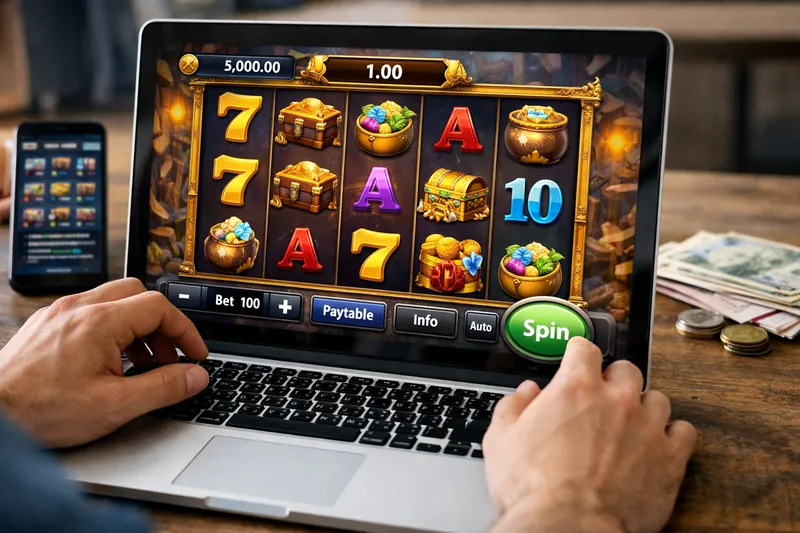
When you open a slot game, you will usually see your balance, current bet size, the spin button, a rules or info section, and sometimes an autoplay option. The basic sequence is simple, but beginners should slow down during the first few spins so they can understand the interface before speeding things up.
The usual steps are:
- Choose a game with a clear interface and a low minimum bet.
- Open the info section or paytable to review the symbols, payout rules, and special features.
- Set a bet size that fits your budget, keeping it small when you are just starting.
- Spin manually at first so you can observe how the game pays.
- Check your balance after each group of 10-20 spins to understand how quickly the game uses your bankroll.
- Stop if the pace starts to feel too fast or if you notice yourself increasing bets emotionally.
Many beginners turn on autoplay immediately because it feels more convenient. In reality, when you do not yet understand the game, spinning manually is usually better because you can notice when wilds appear, when scatters land, when bonuses trigger, and where most wins tend to come from. Once you are familiar with the game, autoplay can make more sense, but only with clear limits on the number of spins and the amount of money involved.
One practical rule is not to use your entire bankroll on one single game right away. Trying a few titles with small bets helps you learn which games are easier to read, which pace feels comfortable, and whether the balance swings feel manageable. If you want to explore options beyond slots, you can also read casino games for beginners to compare how accessible different categories are.
Paylines, reels, and symbols
This is one of the first things beginners should understand, because if you misread the payout system, you can misjudge the whole game. Paylines are the lines or connection rules used to determine winning combinations. In older-style slots, symbols had to land on fixed lines. In modern slots, some games pay from left to right, some pay in clusters, some pay both ways, and others pay based on the total number of matching symbols.
A spin is each time you activate the machine and the reels stop on a random combination. Not every spin with attractive-looking symbols is a winner; only combinations that meet the specific rules of the game are counted as payouts. That is why the paytable or information screen is always worth checking first.
Common symbol types include:
- Regular symbols: pay when they appear in a valid winning combination.
- Wilds: usually substitute for other symbols to help complete wins.
- Scatters: often do not need to land on a fixed payline and can trigger free spins or bonus features.
- Bonus symbols: unlock mini-games, pick-and-win rounds, or special features.
- High- and low-value symbols: show the difference in payout potential among symbol types.
To make this easier to picture, the table below summarizes the main parts beginners will usually encounter:
| Element | Meaning | What beginners should watch for |
|---|---|---|
| Paylines | The rules used to determine winning combinations | Do not assume every slot pays the same way |
| Reels | The symbol columns that stop after each spin | More reels do not automatically mean easier wins |
| Wild | A substitute symbol | Check whether wilds can replace scatters |
| Scatter | A feature-triggering symbol | Often the key to unlocking free spins |
| Free spins | Free rounds that may include multipliers | Read the trigger rules and payout method carefully |
| Bet size | The amount used for each spin | Directly affects how long your bankroll lasts |
Many beginners see two scatter symbols land and think the game was “almost ready to hit.” In reality, that is mostly a psychological reaction. The game does not remember that you almost triggered a feature and then raise your chance on the next spin. Understanding that matters, because it helps you avoid increasing your bet just because you were “one symbol away.”
RTP, volatility, and why they matter

RTP stands for Return to Player and refers to the theoretical percentage a game gives back over a very large number of spins. For example, an RTP of 96% means that, in theory, the game returns $96 for every $100 wagered over the long run. The important thing to remember is that RTP is not a promise for one short session. You can still win big or lose quickly over a few dozen spins, even in a game with a relatively high RTP.
Volatility shows how a game tends to pay. Low-volatility slots usually produce smaller wins more often, while high-volatility slots may go longer without paying but can deliver bigger hits when they do. For beginners, this idea is often even more practical than RTP because it affects the feeling of play and the speed at which your balance can rise or fall.
A simple way to look at it:
- RTP helps you judge the game’s theoretical quality over time.
- Volatility tells you whether the session is likely to feel smoother or more aggressive.
- Looking at both together gives you a more realistic view of the playing experience.
A game with decent RTP but very high volatility can still be a poor fit for a beginner with a small bankroll. You might face many losing spins in a row and feel tempted to chase losses. By contrast, low- or medium-volatility games are usually easier to follow and better for learning because the balance often moves less violently.
If you want to switch to a slower-paced experience where you can watch events unfold in real time, you can also read if you want to try live tables. These two game groups feel very different in both pace and decision-making.
One simple tip I often give beginners is to favor games with publicly listed RTP and clearly described volatility. When a provider or casino does not show basic information, it becomes harder to judge the game calmly. Transparency is always a better sign than flashy presentation.
How to choose a slot that suits beginners
Choosing the right game from the start makes learning easier and less stressful. Beginners do not need to chase the hottest slot or the biggest jackpot, because those games often come with higher expectations and stronger swings. At the beginning, the goal should be to understand the rules, follow your balance, and build steady betting habits.
When choosing your first slot, it helps to prioritize these points:
- A low minimum bet so your bankroll is easier to control.
- A clear interface with buttons and paytable information that are easy to understand.
- A simple bonus structure without too many layered features.
- RTP that is shown openly.
- Low or medium volatility if you are new to slots.
- A spin speed that is not too fast, so you can follow each round.
It also helps to ask yourself what you want from your first session. If your goal is to learn, a simple game is usually better than one overloaded with effects and bonus mechanics. If your goal is light entertainment on a small budget, avoid slots that only start to feel interesting at higher bet sizes. If you are still deciding between broader game categories, the homepage overview of online casinos for beginners can help you place slots within the wider game landscape.
The key point is to choose a game that matches how you want to learn, not a game someone else claims is “easy money.” There is no guaranteed winning formula in slots. The closest practical advantage is choosing a risk level that fits you personally. The more consistently beginners follow that idea, the steadier the experience usually feels.
Common mistakes when playing slots

Most beginner mistakes do not come from pressing the wrong button. They come from expectations and emotional control. Slots move quickly, use strong visual effects, and can deliver sudden rewards, so it is easy to believe that just a few more spins will recover losses or trigger a bonus. That is often when the bankroll disappears the fastest.
The most common mistakes include:
- Increasing your bet after several losing spins in a row to try to recover losses.
- Focusing only on jackpots or big-win advertising while ignoring RTP and volatility.
- Skipping the paytable and misunderstanding how payouts work.
- Letting autoplay run too long without a stopping limit.
- Playing while tired, frustrated, or trying to win back earlier losses.
- Switching games constantly because you think a new one will be more likely to hit.
- Treating “near misses” as signs that a big win is close.
All of these mistakes usually come from the same root problem: letting emotion control the pace of play. The best fix is to set a framework before you start, such as using one fixed small amount, refusing to raise bets during the first session, stopping after a certain number of spins, and taking a break as soon as you notice frustration or urgency creeping in. If you want a broader look at the behaviors that often cause beginners to lose control, the article on common beginner mistakes is worth reading.
The main thing to remember is that slots do not reward blind persistence. Spinning more because it fits your plan is one thing; spinning more because you cannot accept stopping is something else entirely. For beginners, knowing when to stop is often more important than knowing which game to pick.
Frequently Asked Questions
Below are some of the most common questions beginners ask when they first start learning about online slots. The answers are short, practical, and easy to apply right away.
Do online slots require skill?
Slots do not require strategic skill in the same way blackjack or poker does, because each spin result is random. However, players still need useful skills in other areas: understanding the game rules, choosing sensible bet sizes, reading RTP and volatility, and managing a bankroll. In other words, you cannot control the spin result, but you can control how you approach the game.
Does a high RTP mean it is easier to win?
It is better not to read RTP too directly. A high RTP suggests a better theoretical return over many spins, but it does not guarantee that you will win in one short session. When choosing a game, look at RTP together with volatility. A high-RTP game with strong volatility can still drain a small beginner bankroll quickly.
Should beginners choose low- or high-volatility slots?
In most cases, low- or medium-volatility slots are a better fit. These games usually provide a steadier experience, help you observe how the rules work, and reduce the chance of your balance dropping too sharply in only a few spins. High-volatility slots can be exciting because of their larger payout potential, but they create more pressure and are less beginner-friendly when the bankroll is limited.
Should I use autoplay when I am new?
You can, but it is usually better not to use it right away and never let it run without limits. When you are still learning, manual spins make it easier to understand the symbols, bonus triggers, and speed of bankroll changes. If you do use autoplay, set a fixed number of spins and decide on a maximum loss in advance so you do not end up playing on autopilot.
How do I know whether a slot is right for me?
Focus on four things: the minimum bet, how easy the interface is to understand, whether the RTP is shown clearly, and the volatility level. A beginner-friendly game is usually easy to read, allows small bets, avoids overly complex mechanics, and does not swing the balance too hard. If after a few dozen spins you still feel confused by the rules or keep wanting to raise your bet just to feel something happening, that game may not be a good fit for your starting stage.
 Baccarat Online for Beginners - Basic Rules
 How to Play Online Casino Games - An Easy Guide
 How to Choose a Reputable and Safe Online Casino
 How to Register for an Online Casino Quickly and Safely